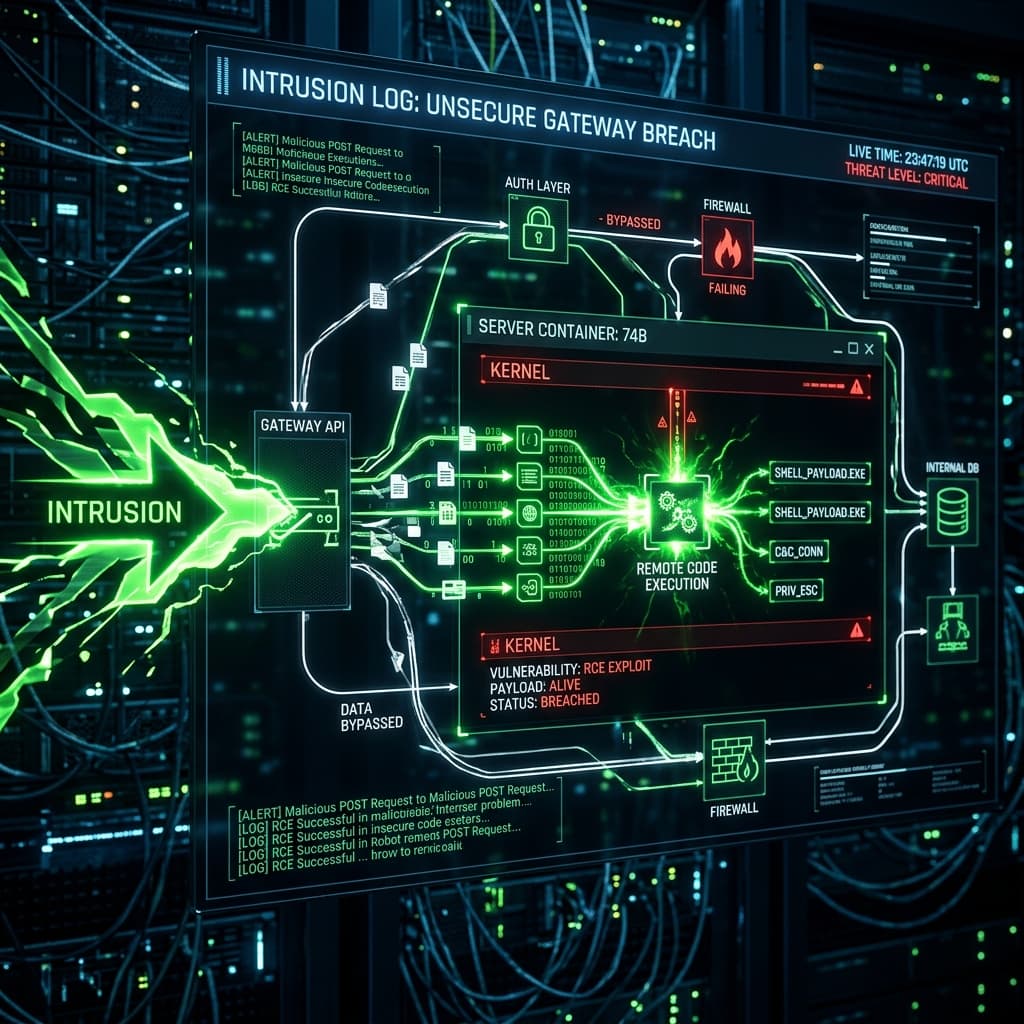
Vulnerability Overview
Disclosed in March 2026, CVE-2026-33032 is a critical vulnerability affecting Nginx UI, a popular web-based interface for managing Nginx configurations. With a CVSS score of 9.8, this flaw allows remote, unauthenticated attackers to completely bypass security controls, gain access to the administrative dashboard, and leverage the built-in system terminal to execute arbitrary commands as the root user inside the running host container.
Exploitation Status: Active exploitation of this vulnerability in the wild has been confirmed by threat intelligence feeds. Honey pots have observed mass scans searching for exposed Nginx UI management interfaces.
Technical Details
The vulnerability stems from the implementation of Nginx UI's web terminal, which runs over WebSockets (/api/terminal). The authentication middleware fails to validate JWT tokens on WebSocket upgrade requests, allowing connection requests to pass through unchecked.
Attack Vector
- An attacker initiates a WebSocket connection directly to the
/api/terminalendpoint. - The upgrade request is processed without checking token parameters.
- The system spawns a pseudo-terminal (
pty) linked to the container's shell (/bin/sh). - The attacker gains full interactive shell access, allowing them to download malware, steal SSH keys, and run lateral reconnaissance.
Mitigation & Remediation
Organizations employing Nginx UI to orchestrate their routing gateways must deploy mitigation fixes immediately.
1. Upgrade Immediately
Upgrade your Nginx UI deployments to version v2.0.0-beta.9 or higher where proper WebSocket token validation has been fully implemented.
If utilizing Docker, pull the latest image and restart your stack:
docker compose pull nginx-ui
docker compose up -d
2. Disable Public Exposure
Never expose infrastructure administration dashboards directly to the public internet. Ensure your Nginx UI panel is behind:
- A secure WireGuard VPN tunnel.
- A protective access proxy requiring robust OAuth/OIDC authentication.
Threat Response Advisory
Our intelligence team monitors these vulnerabilities 24/7. For real-time threat detection and custom mitigation playbooks, contact our SOC response unit.