Vulnerability Overview
Disclosed in late May 2026, DirtyClone (CVE-2026-43503) is a critical local privilege escalation (LPE) vulnerability that belongs to the same family of page-cache corruption vulnerabilities as CopyFail, DirtyFrag, and Fragnesia.
By exploiting a logic flaw in how the Linux kernel handles page ownership for cloned socket buffers (sk_buff or skb), a local attacker can write arbitrary data directly into read-only system files stored in the kernel's Page Cache. This modification occurs entirely in physical memory, bypassing file system write protections and disk-based audit mechanisms. Attackers can overwrite common setuid binaries (like /usr/bin/su or /usr/bin/sudo) in memory to spawn an interactive root shell.
Critical Warning
Exploitation Status: While exploitation is highly reliable, it typically requires unprivileged user namespaces (CAP_NET_ADMIN) to configure the network interfaces needed to trigger the flaw.
Technical Details
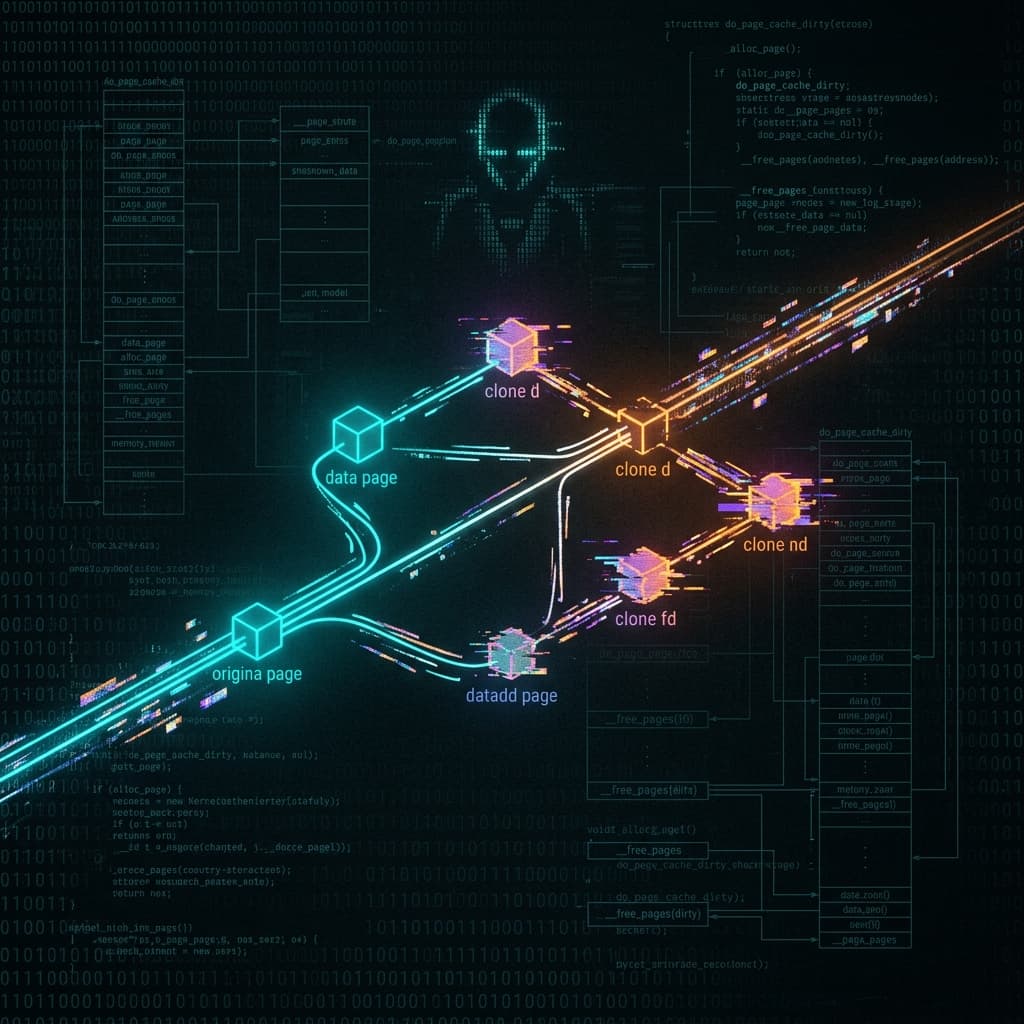
The root cause of DirtyClone lies in the kernel's memory management and network buffer cloning subsystems. When the kernel clones a network packet using helper functions, it creates a copy of the buffer headers while keeping reference counts to the underlying data pages (fragments).
If these fragments are backed by a file mapped via the splice() or sendfile() system calls, they must be marked as shared and immutable using the SKBFL_SHARED_FRAG flag.
In vulnerable kernels, certain helper functions failed to propagate the SKBFL_SHARED_FRAG marker to cloned buffers. As a result, subsequent inline modifications (such as IPSec ESP decryption or socket operations) assumed exclusive ownership of the page and modified the data in-place without triggering a Copy-on-Write (COW) operation. Because the page was actually still shared with the page cache, the modification corrupted the cached copy of the file in memory.
Technical Exploit Flow
Mitigation & Remediation
System administrators and cloud operators should patch host operating systems immediately.
1. Update Linux Kernel
Apply the security updates from your Linux distribution. The mainline patch ensures that SKBFL_SHARED_FRAG is properly set and propagated during socket buffer cloning operations.
Ubuntu / Debian:
sudo apt update && sudo apt upgrade linux-image-generic -y
sudo reboot
RHEL / Rocky Linux:
sudo dnf update kernel -y
sudo reboot
2. Restrict Unprivileged User Namespaces (Mitigation)
Since the exploit typically requires local network administration capabilities (CAP_NET_ADMIN) to configure specific IPsec policies or socket filters, disabling unprivileged user namespaces blocks the attack vector.
To apply this mitigation immediately:
sudo sysctl -w kernel.unprivileged_userns_clone=0
To make the setting persistent across reboots, add it to /etc/sysctl.d/:
echo "kernel.unprivileged_userns_clone=0" | sudo tee /etc/sysctl.d/99-disable-userns.conf
(Note: Disabling namespaces may break rootless container environments such as rootless Podman or rootless Docker.)
Threat Response Advisory
Our intelligence team monitors these vulnerabilities 24/7. For real-time threat detection and custom mitigation playbooks, contact our SOC response unit.