Vulnerability Overview
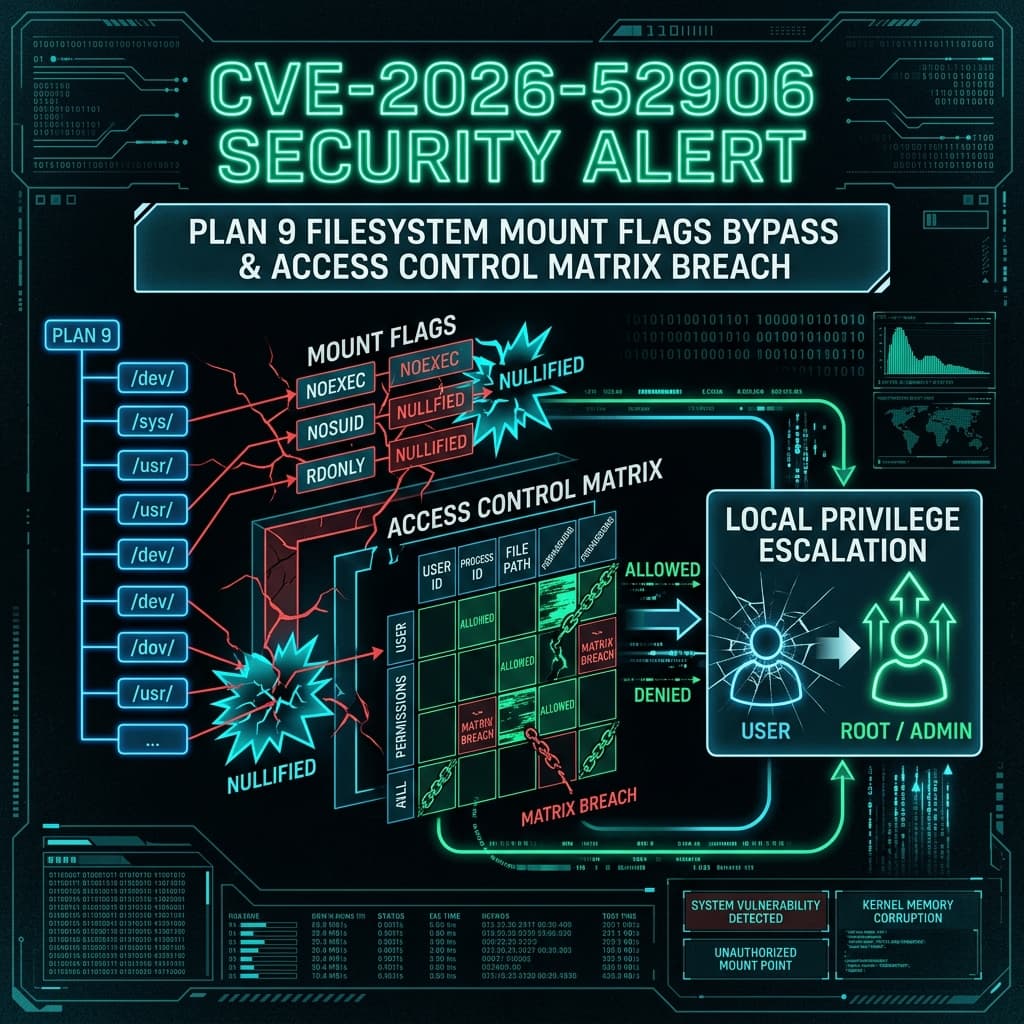
Disclosed on June 9, 2026, CVE-2026-52906 is a privilege escalation vulnerability in the Linux kernel Plan 9 (9p) filesystem client. The flaw resides in how mount flags are evaluated during user-initiated mount actions when utilizing unprivileged user namespaces.
An unprivileged local attacker can exploit this flaw to mount a 9p share while bypassing mount-time access control policies (like nosuid and noexec). This enables the execution of setuid-root binaries hosted on a remote or manipulated local 9p server, resulting in local privilege escalation to root.
Technical Details
The Linux kernel enables unprivileged users to mount filesystems inside separate user namespaces, provided that the filesystem is flagged as safe. The Plan 9 filesystem implementation (v9fs) registers client mounts with dynamic option parsing.
The issue stems from a logic error in v9fs_mount() where the kernel fails to propagate namespace-specific security attributes (e.g., MNT_LOCK_NOSUID) to sub-mount points. When mounting a sub-directory from an existing 9p connection, the system fails to apply the safety boundaries inherited from the parent mount.
Attack Vector
- An attacker creates a new user/mount namespace (
unshare -U -m). - The attacker mounts a 9p directory pointing to a controllable source (such as a local mount emulator or proxy).
- The attacker accesses a sub-mount that contains a setuid root binary.
- Because the safety flags were not inherited, the binary executes on the host with full root privileges.
Mitigation & Remediation
Organizations should patch their Linux nodes immediately, particularly those running virtualization environments or WSL2 instances that utilize 9p for host-guest file sharing.
1. Update Linux Kernel
Distributions have released updates containing patches that enforce mount flags checking recursive structures. Ensure your systems are upgraded:
# Red Hat Enterprise Linux / Rocky Linux
sudo dnf update kernel-y && reboot

# Debian / Ubuntu
sudo apt update && sudo apt upgrade linux-image-generic && reboot
2. Disable Unprivileged User Namespaces (Temporary Workaround)
If patching is not possible immediately, you can block the namespace creation vector required to execute this exploit:
# Disable unprivileged namespaces
sudo sysctl -w kernel.unprivileged_userns_clone=0

# Persist configuration
echo "kernel.unprivileged_userns_clone=0" | sudo tee -a /etc/sysctl.conf
Threat Response Advisory
Our intelligence team monitors these vulnerabilities 24/7. For real-time threat detection and custom mitigation playbooks, contact our SOC response unit.